

Carl's
Casino Quotes
& Commentary
Gladys Kravitz
Middleboro Remembers
Ryan's Take
Stop Predatory Gambling
Truth to Power
Don't miss these
- Lista Casino Non Aams
- Casinos Not On Gamstop
- Non Gamstop Casino
- UK Casinos Not On Gamstop
- Casino Online Non Aams
- Non Gamstop Casino Sites UK
- UK Casino Not On Gamstop
- Slots Not On Gamstop
- Meilleur Casino En Ligne
- Casino En Ligne
- Meilleur Casino En Ligne
- UK Casinos Not On Gamstop
- Non Gamstop Casino
- Migliori Siti Casino Non Aams
- Casino Sites UK
- Non Gamstop Casinos
- Casinos Not On Gamstop
- Non Gamstop Casino Sites UK
- Online Slots UK
- UK Casino Sites Not On Gamstop
- UK Online Casinos Not On Gamstop
- Casino Sites Not On Gamstop
- UK Casino Not On Gamstop
- Slot Online Migliori
- Slots Not On Gamstop
- Crypto Casino
- Pari En Ligne Belgique
- Meilleur Casino Belgique
- Migliori Siti Casino Non Aams
- 씨벳
- Casino Bonus Gratuit Sans Depot Francais
- Bonus Sans Depot
- Cresus Casino Argent Fictif
- Casino Senza Verifica
- Siti Casino Non Aams
- Siti Non Aams Legali In Italia
- Bookmaker Non Aams
- Casino En Ligne Argent Réel
- Casino En Ligne Français
- Casino En Ligne Qui Paye Rapidement
- Casinò Non Aams
- Casino Non Aams Sicuri
- Migliori Casino Online
- I Migliori Siti Di Poker Online
- Migliori Casino Non AAMS
- Casino Online Esteri
- Nouveau Casino En Ligne
- Meilleur Site De Poker
- Casino En Ligne
- Casino Crypto
- Migliori App Poker Android
- Bookmaker Non Aams
- Bookmaker Non Aams

COMMON MYTHS ABOUT CASINOS & SLOT MACHINES |
||||

| ||||
| MYTH #1 - Massachusetts is losing billions of dollars to Connecticut casinos. |
||||
|
Simply untrue. It's estimated that Massachusetts residents contributed approximately $93 million to the Connecticut treasury in CY 2009 as a result of gambling. This is close to the amount we would lose with an expected 10% hit to the lottery. Other costs associated with expanded gambling are seldom factored into gambling export figures. To establish casinos and slot parlors in Massachusetts would require a new multi-million dollar regulatory bureaucracy in excess of $20 million. Increased crime, impacts to communities and the need for social services also greatly increase costs. Negative effects on local businesses reduce tax revenue. If tribal casinos are established, there will be further lost tax revenues as well as increased legal costs associated with Indian affairs.
| ||||
| MYTH #2 - Casinos will provide thousands of good jobs. |
||||
|
Casinos will create temporary construction jobs, as will other industries which don't require a new bureacracy to regulate or increace crime and addiction. As for permanent jobs, the great majority of jobs at casinos can regularly be found on the Forbes list of worst paying jobs in America - including that of 'gaming dealer'. USS Mass supports sustainable job creation and economic development. Slot parlor and casino job numbers and incomes have been widely overstated by proponents. According to the 2007 National Compensation Survey compiled by the US Dept of Labor's Division of Labor Statistics the median hourly wage for gaming service employees is estimated at $6.34 per hour with annual median earnings of $13,179 (pg. 13.) Spectrum Gaming soundly refuted the job creation numbers projected in Governor Patrick's legislation to approve three casinos that was defeated in the Legislature in 2008. Economic development continues to be overstated by proponents who never account for jobs lost from businesses that fail due to the all-encompassing predatory nature of casino capitalism. Just take a look at the example of Hollywood Slots in Bangor Maine. For this and many other critical reasons, USS Mass has called upon the Legislature and the Governor to develop a blue-ribbon commission to perform a comprehensive, balanced, data-driven, cost-benefit analysis of predatory gambling before licensing slots or casinos in the Commonwealth |
||||
| MYTH #3 - The tax revenue from slots will balance budgets, lower taxes and
send more money to cities and towns. |
||||
|
Tax revenues from casinos are lower than projected just two years ago due to the global recession. Mitigation costs continue to rise. Expansion of government to manage the corporate casino industry that has known negatives such as traffic and public safety, crime, bankruptcy, family violence and other social problems creates enormous fiscal burdens on communities and taxpayers. In June, Massachusetts Attorney General Martha Coakley, informed the legislative Committee on Economic Development and Emerging Technologies that other states with regulatory commissions on predatory gambling employ staff of over 500 people alone. Funding for this commission is not included in legislation, and hidden costs such as this will take a huge chunk of that "new revenue". Surveillance, money laundering, purchase of technology and personnel alone will consume hundreds of millions of dollars. Local impacts in the hundreds of millions of dollars will either be paid by the state of the local taxpayers. Connecticut Attorney General Blumenthal confessed at a public forum on casinos that the state of Connecticut made a huge mistake through not planning for or adequately mitigating the local impacts. Revenues from CT casinos have been dispersed throughout the state with the host regions starved of needed funds. It is the position of USS Mass that the Legislature and the Governor have a fundamental responsibility to the people of the Commonwealth to perform a comprehensive, balanced, data-driven, cost-benefit analysis of predatory gambling before licensing slots or casinos in the Commonwealth. |
||||
| MYTH #4 - Slots will save the State's racetracks. |
||||
|
The people of Massachusetts voted overwhelmingly to close the race tracks last year through Ballot #3. Predatory slot machines are designed to addict players and are a regressive tax policy. The Commonwealth provided for tax-funded job re-training for employees of the tracks to off-set any losses to their employment. | ||||
| MYTH #5 - We need to recapture the money going to out-of-state casinos. |
||||
|
A small percentage of Massachusetts residents gamble in facilities located in other states. The re-capture of these revenues that have been exaggerated to be as high as a billion dollars a year are in reality almost half that figure.
The amount of gambling revenue that "goes out-of-state", would be re-captured through taxation at approximately 27% according to past and current legislative proposals. According to a Greater Boston Chamber of Commerce report commissioned in March 2008, if the lottery takes a 10% hit from the introduction of casinos and slots, as it is expected to do, state lottery transferred as state aid to towns and cities will be reduced by about $90 million. Unlike casinos and slot parlors, the lottery returns the vast amount of it's profits directly to cities and towns. Massachusetts cannot afford this hit to the Lottery. Proximity to predatory gambling increases addiction within a 50 mile radius by double. The map below illustrates those areas of the state located within 50 miles of proposed casino locations in East Boston, Palmer, and Southeastern Mass. 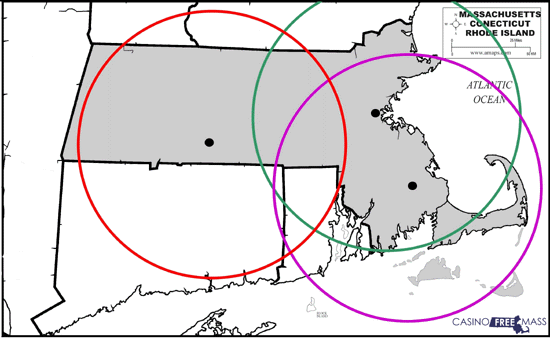 The costs of managing local increases in addicted and problem gamblers, impacts to municipalities, air and water pollution are additional reasons why USS Mass recommends in the strongest terms, that the Legislature and the Governor perform a comprehensive, balanced, data-driven, cost-benefit analysis of predatory gambling before licensing slots or casinos in the Commonwealth. | ||||
| MYTH #6 - Gambling is just another form of entertainment. |
||||
|
Not for those who are addicted. The casino industry depends on people "playing to extinction." This is a form of entertainment for some, and a way of life for too many. Massachusetts residents and Legislators reject predatory lending, drug and tobacco predatory marketing and product misrepresentation. Slots are designed to psychologically prey upon the user. Revenues from addicted and problem gamblers have been analyzed by national expert Professor Grinols to provide 70-80% of all revenues. Therefore, the business model is designed to receive profits from addicted users, not "entertainment". "Entertainment" is the cloak surrounding the predatory core of the slot machine product and the business model. "Gaming" became the code word for "gambling" in the industry's marketing vernacular to disguise the core of the business. Gambling by another word is still gambling. | ||||
| MYTH #7 - Any new form of revenue is good revenue. |
||||
|
Revenue is only positive revenue if it is a net profit and does not harm people and society. Predatory gambling revenues do neither. | ||||
| MYTH #8 - The benefits from expanded gambling out-weigh any costs. |
||||
|
Really?
Let us repeat our call for the Legislature and Governor to perform their fundamental responsibility to the people of the Commonwealth to perform a comprehensive, balanced, data-driven, cost-benefit analysis of predatory gambling before licensing slots or casinos in the Commonwealth. 40 States, including California, have legalized expanded gambling for revenue purposes. California is almost bankrupt. Our taxes are lower than those in PA, CT, and NJ. | ||||
| MYTH #9 - Slot parlors are better than casinos, and will produce almost instant revenue. |
||||
|
Actually, slot parlors are worse. 10% of the players account for 90% of the profit, and in this economy, that 10% are those already suffering. This is simply regressive in nature and little job development is created. Money is sucked from the local and regional economies with small businesses and municipalities negatively fiscally impacted. | ||||
| MYTH #10 - If federally recognized Native American Tribes can build tax-free casinos in Massachusetts, the State would be better off legalizing slots and taxing commercial casinos. |
||||
|
In fact, the opposite is true. Keeping slots illegal in Massachusetts prevents the establishment of tribal casinos. But legalizing slots makes tribal casino more likely. When the Mashpee Wampanoag Tribe received federal recognition in February 2007, many people beleived that Class III gambling (slots machines) would be inevitable in Massachusetts. This bit of misinformation was used to convince many Middleboro voters to believe that a casino was inevitable. Tribes cannot engage in any form of gambling on their sovereign territory that is not legal in the state. The state cannot be compelled to sign a compact for gambling with a tribe. What about the "Vegas Night" exception? Can having legal one-night charity games open the door to tribal 'gaming'? No. Texas, like Massachusetts, has a lottery and Vegas Nights (one night licenses to operate slot machines for charity) but slots are illegal. Tribes there tried to prove that this created precedent for allowing tribal there casinos to offer slots. But courts disagreed that this wasn't a compelling argument since Texas has shown a consistent history of opposing level III gambling. Like Massachusetts. Tribal gambling enterprises must be established on tribal lands - sovereign territory - property that has been removed from state tax rolls and taken in trust for the tribe by the federal government. There is a separate, even more complex process required for taking land in trust for 'gaming'. In some cases, the host community must approve the application. In any event, tribes must submit a detailed application to the government to put any land into trust, and it is not always a sure thing. In recent years regulations regarding the taking of land into trust, especially for 'gaming' have become more restrictive. Matters were further complicated for the two federally recognized Massachusetts tribes, the Mashpee and the Aquinnah Wampanoag when, in February 2009, the the Supreme Court of the United States ruled in the case of Carcieri v. Kempthorne (now known as Carcieri v. Salazaar) that the Indian Regulatory Act did not apply to tribes recognized after 1934. Consequently, the Indian Gaming Act would also no longer apply to tribes recognized after 1934. Both of these Massachusetts tribes were federally recognized well after 1934. Shortly after the Salazar decision, in Hawaii v. Office of Hawaiian Affairs, the Supreme Court ruled that, "Congress cannot, after statehood reserve or convey submerged lands that have already been bestowed upon a State" - further reducing the likelihood of any Federal land-in-trust acquisitions in Massachusetts. In her testimony before the legislative Committee on Economic Development and Emerging Technologies in June 2009, Massachusetts Attorney General Martha Coakley stated that "The Supreme Court's decision this past February in the Carcieri case effectively puts the Wampanoags and other tribes in Massachusetts on the same footing as any other private party because the Secretary of the Interior's ability to acquire land for Native Americans is limited to those already under Federal Jurisdiction at the time the Indian Reorganization Act was enacted in 1934. Massachusetts' Native American tribes each came under Federal Jurisdiction after 1934. As a result, they are entitled to make an application and bid for a gaming license like anyone else, but do not have special entitlement to conduct gaming under the federal Indian Gaming Regulatory Act or the Indian Reorganization Act."However, if a state does legalize class III gambling, either through casinos, racinos or slot parlors, Tribes can ask Congress to give them land into trust for 'gaming', claiming the state has an unfair economic advantage, and they would have a good case. For example, Florida had consistently managed to keep the Seminole tribe from winning their bid to bring slots to the state. The Tribe was allowed to offer level II gambling (the much less lucrative bingo slots which managed to attract gamblers mainly because there was no other slot-style 'gaming' for 600 miles around.) But Vegas-style slots are where the big money is. The courts, however, consistently backed Florida by ruling that the State did not have to sign a compact for expanded gambling with the Tribe. But then the State granted a slot licence to a racetrack, and the tribes were allowed to open full-fledged mega casinos. It should be noted that there are currently 2 recognized Indian Tribes in Massachusetts, and 6 other Tribes which could seek recognition. Approving slots at the racetracks could open the door to 8 Massachusetts casinos. | ||||